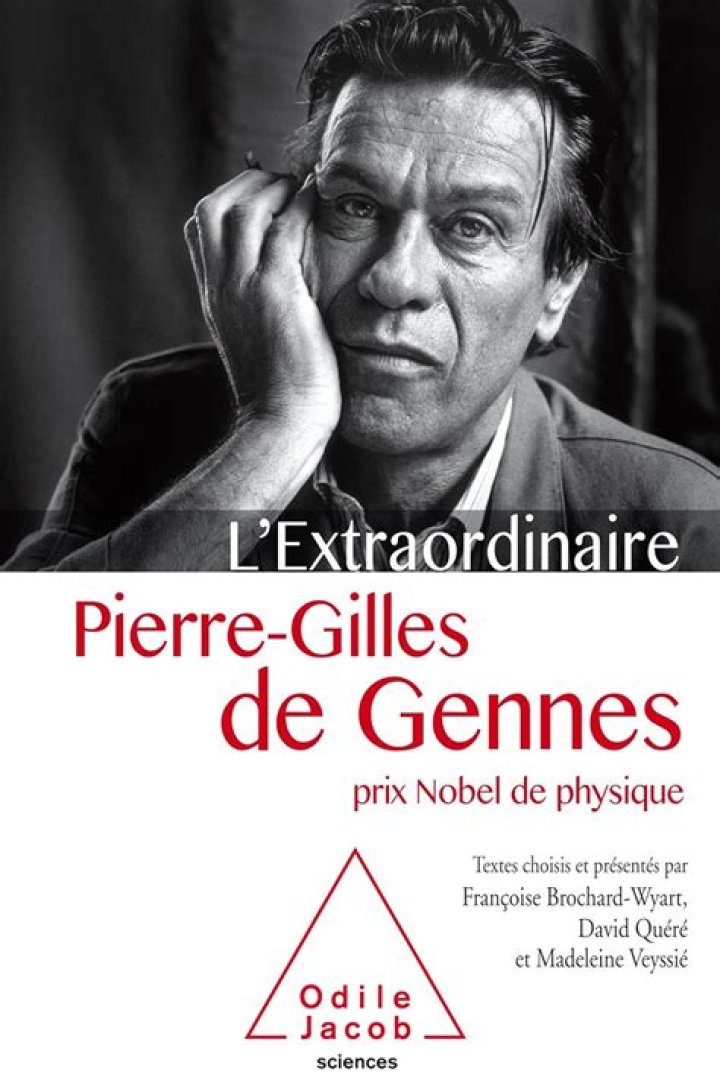
Pierre-Gilles De Gennes Biography - Childhood, Life Achievements & Timeline
 Isabella Harris
 science
Pierre-Gilles de Gennes Biography
(Physicist)Birthday: October 24, 1932 (Scorpio)
Born In: Paris, France
Advanced SearchPierre Gilles de Gennes was a French scientist, well-known for his study of the order phenomena in liquid crystals and polymers. He won the Nobel Prize in Physics in 1991 for the above mentioned work and was described as the ‘Isaac Newton of our time’ by the Nobel committee. Born to a nurse and a physician in Paris, France, he was initially schooled at home and subsequently studied at the Ecole Normale Superieure. Eventually, he became an engineer at Atomic Research Centre and was awarded his doctorate by the institute. He did his post doctoral research in the United States and after working for just over two years for the French Navy, he became a professor at the University of Paris-Sud, Orsay campus. Subsequently, he worked at the College de France as a professor and researcher before going on to become the director of the Ecole Superieure Physique et de Chimie Industrielles. He continued in the latter post for 22 years. His findings in relation to liquid crystals and polymers are considered to be one of the most significant findings in the history of physics. Quick FactsFrench Celebrities Born In October
Died At Age: 74
Family:Spouse/Ex-: Anne Marie Elisabeth Eugenie Rouet
father: Robert Joachim Pierre de Gennes
mother: Martha Marie Yvonne Morin-Pons
place of death: Orsay
City: Paris
More Factseducation: École Normale Supérieure
awards: ForMemRS (1984)
Matteucci Medal (1987)
Harvey Prize (1988)
Lorentz Medal (1990)
Wolf Prize (1990)
Nobel Prize for Physics (1991)
Eringen Medal (1998)
Recommended For You
Recommended Lists:
French CelebritiesMale PhysicistsMale ScientistsScorpio ScientistsFrench Scientists Childhood & Early LifePierre Gilles de Gennes was born on 24 October 1932 in Paris, France to Robert Joachim Pierre de Gennes and his wife Martha Marie Yvonne Morin-Pons. His father was a physician, while his mother worked as a nurse.He did not go to a traditional school and tutored at home and that continued till the time he was 12-year-old. Subsequently, he enrolled at the Ecole Normale Superieure and graduated from there in 1955. One of his key subjects at the Ecole Normale Superieure was German.In 1955, he started working in the capacity of a research engineer at the Atomic Research Centre, located in the region of Saclay in southern Paris. Two years later, he was awarded his doctorate by the institute. During his time at the Atomic Research Centre, he was primarily involved in the field of magnetism and neutron scattering.Continue Reading BelowRecommended Lists:French PhysicistsScorpio MenCareerIn 1959, he went to the United States as a visiting post doctoral scholar at the University of California, Berkley. He worked alongside another well-known researcher of the time, Charles Kittel during his stint at Berkeley. Subsequently, he went to work for the French Navy and worked for them for a period of 2 years and three months.After the completion of his stint with the French Navy, he was appointed as a professor at the Orsay campus of the University of Paris-Sud in 1961 and before long he founded the group ‘Orsay group of semiconductors’. He worked on that particular project for a period of seven years before he changed his field to that of liquid crystals.He started working at College de France as a professor in 1971 and during his stint there, he became a part of the joint research on polymer physics initiated by College de France, Starsbourg and Saclay, known as STRASACOL. He worked as a professor at the College de France for a period of five years.In 1976, the Ecole Superieure Physique et de Chimie Industrielles appointed him as director and he continued at the position for 26 years. Four years after joining the institute, he started his research on interfacial studies and the dynamics involved in wetting and adhesion. His research on discovering a process of studying the order phenomena in liquid crystals and polymers won him the Nobel Prize in Physics.Major WorksHis most important work in a career that saw him conduct several path breaking studies in different institutions is without doubt his work on the order phenomena of different matter that saw him use mathematical techniques to work out general theories on matter. He won the Nobel Prize in Physics in 1990 for the same and was even called the ‘Isaac Newton of our time’ by the committee.Awards & AchievementsHe was made a Fellow of the Royal Society of London in 1984.He was awarded the Matteucci Medal in 1987.In 1988 he won the Harvey Prize.In 1990, he as awarded the Lorentz Medal as well as the Wolf Prize. He was awarded the Nobel Prize in Physics in 1991.In 1998, he won the Eringen Medal.Personal Life & LegacyHe got married to Anne Marie Elisabeth Eugenie Rouet in 1954 and the couple was married till his death. They had three children.He died on 18 May 2007 in Orsay, France, at the age of 74. The reasons behind his death are unknown.